In Protest

The following appeared as a guest post on Abbey of the Arts.
It’s been a difficult year. And not just for me. Too many friends and family have been put through the ringer. Marriages crumbled. People moved. Children got sick. Addictions took over. Dreams were shattered. A mother died. A sister died. A baby died.
These are just the personal tragedies I am privy to. To say nothing of the state of the nation, the wars of the world, the thousands displaced, and the too many abused.
The world is on fire.
Sometimes I think my body forgets that the trauma and stress of the first nine months of the year has passed. I left my husband. My son and I moved into a beautiful, humble town-home surrounded by towering oaks which dropped their acorns with such gusto the week we moved in that I had to keep reminding myself “it’s just acorns, no one is trying to break in.”
Sometimes I am still gripped by anxiety. I have to root around in my brain to pinpoint the monster that provoked the shaking and the fear and ask if it is true, then give it a little hug and send it on its way. Sometimes I get this sudden feeling that I am about to be swallowed by a hideous void. My ribcage swings inward, collapsing my breath. I stare wide-eyed at the black and terrifying unknown. But for the most part, I am breathing better now. For the most part my ribcage swings outward and the wings beneath my shoulder blades unfurl. Shake off dew. Get ready to fly.
In church on Sunday, the rector told a story about a man in the 1960’s who sat outside the White House everyday and lit a candle in protest of the war and violence in Vietnam. One day a man came up and asked, “Do you really think sitting here like this day after day is going to change the world?”
The man replied, “I don’t sit here to change the world. I sit so the world won’t change me.”
When I was a girl I did not understand how once bright and smiling young people could grow old and bitter and mean. I did not believe that the world was broken.
And then I grew up.
Compared to the displaced, the abused, the trafficked, my personal struggles have been very first world. But they have been significant. They have been mine. And they have broken me. Still, I don’t want to be bullied by the cynicism and bitterness I often feel when I look back on the things that didn’t work out and see them as predictors of future failure.
I’ve been fighting to keep mySelf alive ever since the day I graduated High School full of hope and optimism and as much self knowledge and esteem as an eighteen year old can muster. Each time I put on a scarf, or cut my hair, or read fiction I am sending my fist up in defiance against the onslaught of forces bent on beating it out of me. Writing time becomes a statement to my Soul that I will not abandon her.
There are lessons to be learned from this world. The oak and maple and pine around my home speak slow and deep, telling me not to worry. The world is held in an embrace and I am part of that world.
Blessings abound.
My soon to be ex-husband and I remain on good terms. The friend who lost her seven month old baby to cancer is on a healing month in New Zealand – a trip funded by an outpouring of support. The Standing Rock Sioux in North Dakota won a temporary stay on the construction of an oil pipeline that would run under their water supply and along their sacred ground. Our church welcomed and helped settle three refugee families this year. My son’s godmother just sent me a picture of her newborn riding home from the hospital in our old carseat.
The rain falls. The sky remains. The trees hold down the earth, keep it from blowing away.
Last night I set my alarm. This morning I got up and practiced asana, moving my body into shape after shape with only the vaguest agenda. I breathed. I lit my candle. I sat.
A monk of the world in protest.
Of cynicism and bitterness and fear.
This world is going to change me. But I am going to choose how.
Homing Instinct

This post was written as a guest piece for Abbey of the Arts’ “Monk in the World Guest Post” series which poses the question, “How do you live as a monk in the world?”
“Perhaps there is some secret sort of homing instinct in books that brings them to their perfect readers.”
~ The Guernsey Literary and Potato Peel Pie Society by Mary Ann Shaffer and Annie Barrows
A table was set up outside the bookstore at Kanuga, the retreat center where my family and I spent our summer vacation. As so often happens, on our final day there I felt the stirring need to purchase a little token of our time in that scared place. A slim white paperback caught my attention.
The Mockingbird is a journal, published by Mockingbird Ministries “…that seeks to connect the Christian faith with the realities of everyday life in fresh and down-to-earth ways. [They] do this primarily, but not exclusively, via publications, conferences, and online resources.”* Each volume has a theme and this volume, Volume 5, focused on forgiveness. I scanned the table of contents, flipped through the beautifully laid out pages, hesitated, and put it back.
Something larger was at work.
As I moved on, perusing the other items on the table, I felt a tug, as though the book had lassoed a rope around my body and was pulling, drawing me in.
For months I have been struggling with layers of resentment and anger. For months I have been reworking the pages of my novel unable to figure out how to fix it. For years I have been lamenting that my life has, thus far, not turned out the way I envisioned it. I am not yet a bestselling author and humanitarian—a kind of literary Bono.
“Forgive me for the expectations I had of this life.
I had very specific standards that have not been met.
Either through my own failures or those around me.
That I would be Eudora Welty-meets-Mother Theresa.
That I would write tomes of wisdom whiling away my time in an urban ministry program.
Instead I am a mother who lives in the suburbs.
I occasionally remember to donate baby formula to the food pantry…”*
This was the first piece I read (and photographed with my iPhone and texted to my mother and best friend). The anonymous author continues on with an all too familiar litany of standards she set for her life, and all the many ways she struggles with acceptance and gratitude.
Next I read an interview with “The Warden of the World’s Nicest Prison” who affirmed my thoughts about incarceration but which I felt too naive to verbalize. Then I read an essay on forgiveness in marriage. After that came Hearts and Crosses by O.Henry, a story of how we hurt each other and how we forgive.
One of the main scenes in my novel that had been giving me fits was the critical moment where the protagonist forgives herself for all the ways she blamed others for her suffering, and in doing so offers the antagonist an opportunity to do the same. The essential plot and spirit of the scene was right but the setting, the dialogue, and the actions—all the basic elements of story—felt sappy and forced.
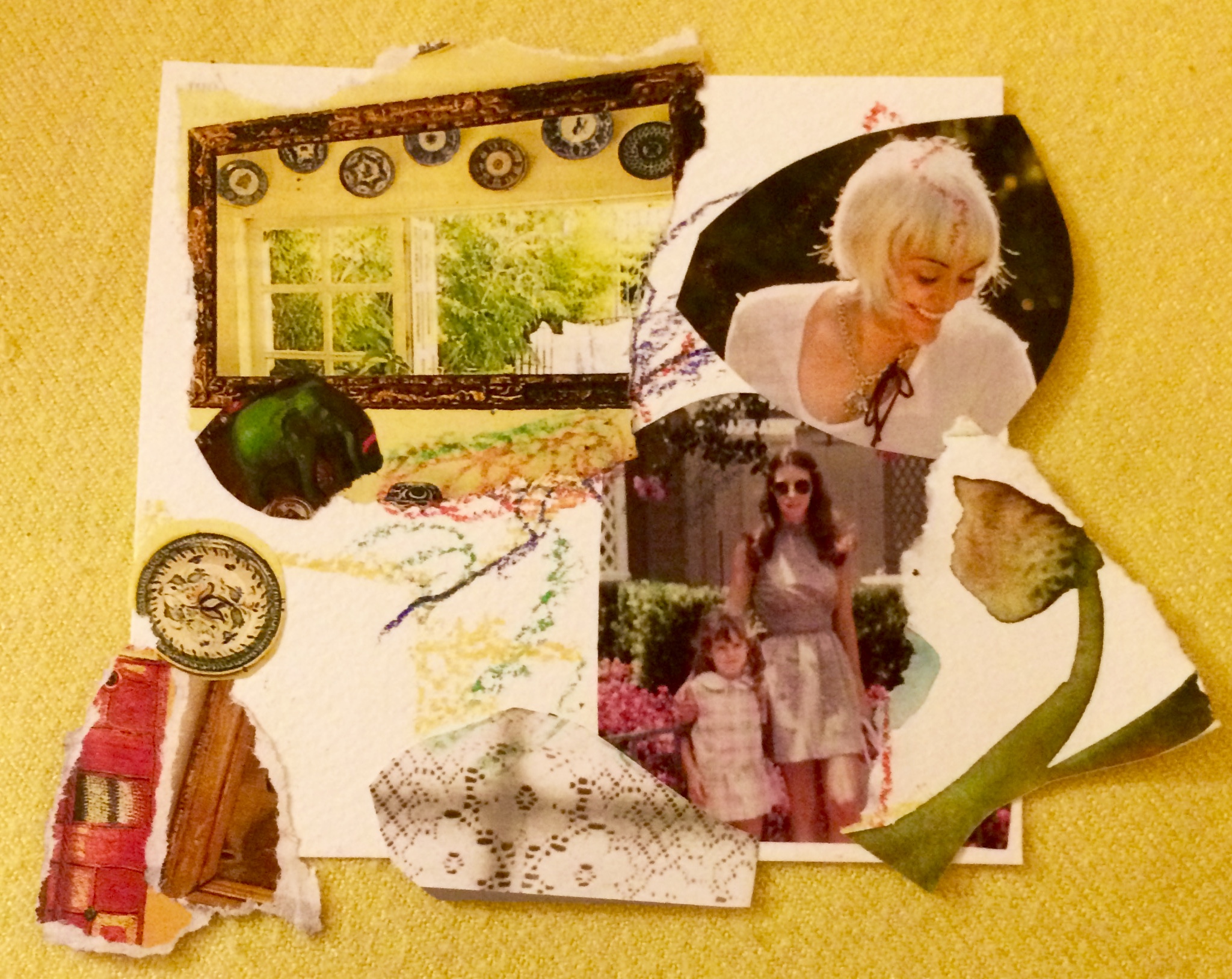 After reading Hearts and Crosses I took out my file of magazine clippings, crayons and watercolor paper, and made some Wisdom Cards. To make Wisdom Cards write a question on three or four pieces of paper, turn them over, and mix them up. That way you don’t know which question you are working with as paste on images and drawings. Each card will have its own flavor. An image on one card just won’t work on another. The pieces hone in on each other and create a new whole. When the collages are finished, turn the cards over, and read the question your art-making has addressed. I always expect direct answers. “This is action a, now take action b.” Fortunately, art is more subtle than that.
Lying in bed that night, after reading Hearts and Crosses, after making Wisdom Cards, words and pictures churned as I faded into sleep: hearts, crosses, forgiveness; the novel, my characters… decoupage… magnolias…summer heat… photographs… an antique store… a kind gesture. And there it was, how to fix the novel.
I may never be the literary Bono I envision myself to be—though I still hold out hope for that possibility. I may never truly rid myself of anger and resentment. What I need to remember is that neither of those things is the point.
What I need to remember is that it’s the process; the movement of the soul, the diving down into the dark, painful places of the heart: the resentment, the disappointment, the selfish grasping, the shame. What I need to remember is the many ways God has, if not answered, evolved the deepest longings of my being.
How do I practice being a monk in the world? I switch on my homing beacon, and listen.
*The Confessional, Mockingbird Volume 5, Mockingbird Press, page 19.
** I highly recommend both Mockingbird and the book “The Guernsey Literary and Potato Peel Pie Society” (which has a fabulous, unabridged audio version).
Melinda Thomas Hansen is mother to a one year old, so living as a monk in the world is a bit more challenging these days. Her touchstone practices are writing, yoga–both teaching and doing–, taking walks and looking at trees. Visit her online at www.thehouseholderspath.com
SACRED BALANCE: ALIGNING BODY AND SPIRIT THROUGH YOGA AND THE BENEDICTINE WAY

Order on Amazon | Barnes and Noble | IndieBound or from any local bookstore
 In Sacred Balance, certified yoga instructor and spirituality blogger Melinda Emily Thomas helps you align body and spirit through two timeless traditions–Benedictine spirituality and yoga practice.
Spirituality in the Benedictine Way offers the commitments of listening, stability, conversion, humility, and hospitality. These root our values and help us choose how to spend our time, devote our energy, and craft relationships. Yoga offers physical postures to bring those principles into body and spirit by relieving pain and stress and helping us gain strength and flexibility. These practices combine to create a powerful blend of body and spirit–one that promises healing and connection to God.
Studded with illustrations of basic yoga poses and ideas for wellness, prayers, and meditations, Sacred Balance offers principles and practices that guide us toward peace and wholeness.
Published by Broadleaf Books. Order Today!
Praise for Sacred Balance
“Sacred Balance offers a profound gift-contemplatives will find kinship with the yogic path, yogis will discover the ways monasticism can nourish them, and those unfamiliar with either will discover a new pathway full of embodied presence.” ~ Christine Valters Paintner, PhD, online abbess of Abbey of the Arts and author of The Artist’s Rule
“Those who wish to integrate the practices of yoga with contemplative Christian sensibilities will want to keep this thoughtful, informed, and deeply sympathetic book nearby.” ~ William K. Mahony, professor and author of The Artful Universe and Exquisite Love
“As beautiful as it is practical, Sacred Balance is an invaluable addition to my library.” ~ Katherine Willis Pershey, pastor and author of Very Married
Love Song
Dear Ones,
 It has been some time since I’ve posted. What precious writing time I have these days is devoted to my journal and to fiction. I’ve been thinking about change, about seasons and relationships and about God. So often we speak of the earth and the seasons like a romance. And we speak of God as love. But love, real love in relationship is mad. Inspired by my own journey, by Advent and the meditations in the book, “In the Sanctuary of Women” by Jan.L. Richardson in which she asks, “Just how much do I want God to know me anyway?” I present…
LOVE SONG
It begins in the dark, as all things do. It begins in the breath before a whisper; the deep, cold space between the stars. The black bones of trees lay bare against a black sky growing grey with the first light. Winter. Below the stars Earth, frozen and dormant. There’s an intelligence there, forgotten in the hard packed crystals of ice. A waiting for something not yet remembered. A sharp intake of Breath; the groan of Earth recalling some deeper warmth.
I know you, She says.
It takes some convincing for Earth to thaw. He wavers around the idea of warmth as space slides between the ice. One day, without realizing it, Spring. A whisper turned into a laugh, a song. The remembrance of a bird, a flower, a tree.
I’m alive, He says.
They flirt, this Earth and Breath. They dance and tumble and birth new animals, new songs, new skies. Their love grows, warmed by Sun. But Sun betrays them. She shines too bright and too strong. Summer. His grasses get scorched; flowers wither and die. Breath pushes rain through Air only to choke.
You almost killed me, She says.
Earth, wondering what happened to his beloved Breath turns only to see that she has found a new love. Wind. Fall. Breath and Wind merge bringing a familiar song to Earth. The ancient chant of ruin and death.
This is what I was afraid of, He says.
Leaves fall. Everything they birthed in Spring unrecognizable now.
I have to go, She says.
The rage in Breath pushing away the last of Sun. Light and warmth fade. The hard-pack of ice returns as Earth goes dormant once again.
Why did you leave me? He asks.
Breath rides Wind over Earth, searching, searching for a way back in; getting caught on the bones in the sky. After Her exhale, the dark. The deep cold space between the stars. The breath before the whisper.
I know you, She says.
 The HouseHolder's Path