Familiar Grace
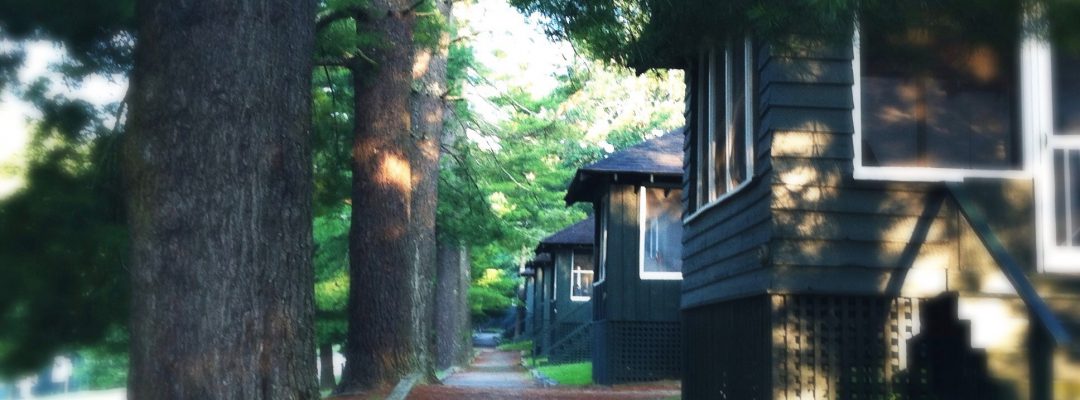
Three days into my family’s yearly vacation at Kanuga Conference Center in Hendersonville I noticed I was in the mountains. At the same place we go every summer. The same cabin, the same embracing forest, the same dear friends, the same food cooked with too much oil.
Why did it take me so long to realize where I was? Familiarity.
It’s so easy to miss the majesty of what is in front of me everyday. Beauty and wonders abound on the short drive from our house to the Y where I sit writing this piece. And yet I missed the moment when the Crepe Myrtles bloomed. If three-year-old Cole hadn’t pointed out a little footbridge over a pond between two apartments, I would never know it exists. I’m embarrassed to note that at first I didn’t believe him.
“We’ve already been under the train bridge, love.”
“No! Over there!”
Touché.
In a recent interview Christine Valters Paintner, PhD of AbbeyoftheArts.com mentions four principles of a contemplative life: silence, pause, wonder, and presence.
In my experience practicing these four principles leads to, among other things, an experience of flow. Of the undercurrent moving beneath, in, around, and through all of life. It shows up in the cycles of birth and life and death. Of forward movement and backward reflection. Of the change of seasons and the phases of the breath. And its ever present nature makes it easy to disregard.
“How is it September already?” we ask. “When did my child grow up? When did my skin start to lose its elasticity? Where does the time go?”
Back in the Anusara days we talked a lot about flow in the context of currents of Grace and attention. Vinyasa defined as moment to moment awareness. Asana as a seat in the heart. I still like this.
From the Kulanavara Tantra ~ “Shakti-nipata- anusarena sishyo’anugraham-arhati.”
“Flowing with Grace (anusare- na) we experience our inner worth, we align our bodies, our minds and hearts in the current of the Divine flowing through us, we celebrate life itself as we touch the Divinity who pulsates within us as our every thought, feeling, and experience.” ~ Dr. Douglas Brooks
When I pause, get still, and marvel at the presence of the natural – the Bleeding Hearts in bloom in the courtyard at church, the pudgy softness of my son’s wrists, the cicada emerging from its shell by my doorway two hours after I booked a much longed for trip to New Mexico – I step into the current of Grace, align my conscious awareness for just a moment in the flow of life outside my self-centered anxiety.
This takes practice.
As we begin the powerful transition of seasons, over the next few weeks I’ll be posting a series on flow. We’ll explore how it affects health, how it looks in nature, how it shows up in contemplative asana, and more.
For today, begin by taking a look at the color of the leaves. Notice the depth of their hue. Their heaviness. And the few already kissed with crimson. Watch for the sap receding back to the core of the tree. Sense the moment when they, when you, in your silence, pause, and stand in wonder at the presence of Grace.
Grace in the familiar you. As the familiar you. All around the familiar you.
Sanskrit for Three Year Olds

For about eight months now my three-year old has been doing yoga with me. He’s pretty proud of his Downward Facing Dog. He can put his hands together in front of his heart and balance for a second or two in Tree Pose. Warrior Three is a new favorite. Headstand II (I hold his feet up) is a particular joy.
Now that I have a clock in his room that glows green – because green means go – when it’s time for him to get out of bed, he’s only present for the tail end of my asana practice. Which is pretty helpful for me because it’s difficult to saturate a pose with breath while engaging in conversation and saying ineffective things such as, “Please don’t dump all the paperclips on the floor.”
But we still get to have “yoga cuddles.”
A yoga cuddle is where he climbs or sits on me while I’m in a seated forward fold or twist. It’s beyond sweet, and sometimes a great assist for rooting the thighbones in the hip socket. Who needs goat yoga when you have a pre-schooler?
He’s started expanding his repertoire of poses and when he sees something he likes, he smiles and tries to replicate it. The other day he tried for a hand-balance and didn’t care one bit that he couldn’t do the pose without my help. I like to rest my forehead on a block when in Wide Legged Seated Forward Fold so he too reached for a block and put it under his forehead while sitting with his legs wide.
The Sanskrit for Wide Legged Seated Forward Fold is Upavista Konasana. I’m no expert but it’s roughly pronounced “Oopa –Vishta – Cone – Aaah – San – A.” Since his verbal skills are increasing in nuance and complexity, I thought I’d try and teach him the Sanskrit name for his poses. It came out:
“Oopa – Veeta – Kan – Ooo – Sana.” Followed by more and more giggles.
Next he and I sat in Baddha Konasana – Bound Angle Pose. “Ba – dah – Cone – Aah – San – A.”
Which became: “Bad-Ha – Koon – Ooo – Sana.”
I love this so much.
He’s so tickled with himself. Tickled by the sounds of new words. I slow it down and try and teach him the correct-ish pronunciation and he just keeps on going with his “oos” because its fun and makes us laugh.
I’m considering refreshing my French or learning Spanish – you know, in my spare time. It would certainly be useful and I’ve always wanted to be bilingual. But I find myself already embarrassed at the ways I will probably butcher the pronunciation, and have thus found one more reason (other than time) not to begin.
In Buddhism and yoga we talk about the idea of a “Beginner’s Mind.” The concept is meant to teach us to approach each moment as fresh, with little assumption so we are open to the reality before us. I imagine Beginner’s Mind to be a place of nervous insecurity. Watching my son, I wonder if perhaps I’m wrong about this. Perhaps I’ve missed the point.
St. Benedict begins his Rule with “Listen carefully, my child, to my instructions, and attend to them with the ear of your heart. This is advice from one who loves you; welcome it and faithfully put it into practice.”
Beginning anew brings us to a place of vulnerability where the not knowing tests our precious assumptions that we need to already know in order to be good enough. But as St. Benedict reminds us, each moment is saturated by the one who loves you. Perhaps this is what it means to have a beginner’s mind.
Perhaps without knowing it, this is what my son is teaching when he giggles through his Sanskrit. “Listen carefully, my child . . . with the ear of your heart.”
Begin with love, laughter and delight.
Why Yoga Works

“Being known by love has its challenges. I think lots of us are also trying to be known as having right answers about things reserved for wonder.” ~ Steve Daughtry
I’m a little embarrassed that I can’t explain how or why yoga works. I can’t show you a chart of subtle body anatomy (or gross body anatomy for that matter) and explain just how the breath pairs with muscle contraction and skeletal placement to bring the sense of ahhhh at the close of an asana practice. I can’t diagram it like a sentence or describe it using higher math. Even if I could, it wouldn’t be sufficient.
Because this is a part of life reserved for wonder.
As I meditate on the things that cause wonder, I begin to notice they are twinned with love. The sound of my son’s laughter. The blueberry color of his eyes. Blueberries. A blue sky. A slate sky. A yellow sky. A smile from a person who usually frowns. The radiance of students during class. Two strong ants dragging a dead wasp.
Like so many of our English words, “wonder” has a double meaning.
As a noun it is: a feeling of surprise mingled with admiration, caused by something beautiful, unexpected, unfamiliar, or inexplicable.
As a verb: to desire or to be curious to know something.
A desire to know, coupled with a feeling of surprise, mingled with admiration at something we cannot explain. That’s a pretty great definition of love. And a spot on description of yoga.
I took the photo above while on vacation in the mountains. This old wood beam edges terraced steps on an often trod hill. Rot in the shape of the heart holds space for young clover.
Wonder twinned with love.
“Being known by love has its challenges.” Not being able to explain it is one.
That Would Be Enough

In response to the violence in Charlottesville, in followup to my last post, In Protest, and with inspiration from three members of the clergy . . .
“That is all very well, little Alice. But there is a third thing you must do,” said her grandfather.
“What is that?” asked Alice.
“You must do something to make the world more beautiful.”
“All right,” said Alice. But she did not know what that could be.
~ Barbara Cooney, Miss Rumphius

To paraphrase our Associate Rector, Rev. Javier Almendárez Bautista, our world has a long history of racial violence. It’s nothing new. Do one thing, one small thing to participate in our life in Christ. That is enough. Rev. Candy Snively, the Deacon at our church, teaches that small acts of kindness can change the world. At 5:45am Sunday morning, my brother, Rev. Adam Thomas, the rector of St. Mark’s Episcopal in Mystic, CT, re-wrote his sermon. It’s a passionate look at the Gospel verses quoted on a sign held by one of the white supremacists in Charlottesville. I implore you to listen to it. “I stand with love,” he says.
To stand with love through small acts of kindness, feels so very small. So insignificant except for the smile they bring to another’s face. A respectful dialogue with someone of an opposite political point of view can feel like a waste of time when it doesn’t lead to a change of heart and mind.
My parent’s have a framed copy of Picasso’s Dove of Peace surrounded with the words, “There is no way to peace. Peace is the way.”
Yoga teaches us that inner peace is a practice and a result of a practice. That life is a particle and a wave. We gentle the breath and experience gentleness. We listen with patience and become patient. If only for a moment. And then, as St. Benedict teaches in his Rule, we begin again. And again and again.
To practice the way of peace, here is a Buddhist Loving Kindness meditation I find helpful. It goes something like this.
- Find a comfortable seat, close your eyes, and tune into your breath. Visualize someone you love. Make them vivid in your mind. Saturate yourself with the feeling of love. Notice the sensation in your body, your forehead, the corner of your lips, your neck and shoulders. Your chest, your belly. Your whole body.
- Keeping this visualization, offer your loved one the following blessing:
May (name) be safe.
May (name) be healthy.
May (name) be happy.
May (name) live with ease.
- Breathe.
- Next do the same for yourself. Then for another person or group of people you care about, or for someone who is ill, injured, abused, etc.
- When you lose the sensation of love come back to the visualization at the start of the meditation.
- Now for the hard part. Bless your enemies. Do what you can to hold the feeling of love while wishing them safety, health, happiness, and ease. It can be a group of people, or a specific person. Notice how the love may feel different here. Notice your forehead, the corners of your lips, your neck and shoulders. Your chest, your belly. Your whole body.
Over the years I’ve prided myself on being able to hold some semblance of love, or some willingness to show love, for people or groups of people – bullies, terrorists, child pornographers (ok, maybe not them) – whom I dislike. The strange thing is, the more I do this meditation, the harder this last part seems to get. Or perhaps I’m getting more honest. I have not yet been successful in blessing our President with anything more than gritted teeth.
“There is no way to peace. Peace is the way.” There is no way to love. Love is the way.
Next week we in North America will experience a total solar eclipse that quite literally, divides the nation from northwest to southeast. For about three hours on a Monday afternoon we will experience a new darkness. And yet . . . And yet, when the moon blocks the sun, those in the path of totality will get to see the corona, the light on the edge of the sun. The part that can only be seen in darkness.
At the end of her homily yesterday, Rev. Candy read to us a few words that have shaped her life. “When you walk to the edge of the light that you know, into the dark of the unknown, you must believe that one of two things will happen. You will be given solid ground to walk on, or you will be taught to fly.”
When you walk to the edge of the love that you know, and into the dark of the unknown – into violence and misunderstanding and fear – you must believe that your small acts of kindness do something to make the world more beautiful. That you do indeed stand with love.
That would be enough.
 The HouseHolder's Path