Plastic Fruits

“Your proper concern is alone the action of duty, not the fruits of the action. Cast then away all desire and fear for the fruits, and perform your duty.” ~ The Bhagavad Gita
I have a tendency to grumble, to get cynical, to be in anxiety and fear and tell myself the story that I’ve taken many wrong turns in life and that is why my work does not seem to bear fruit in the way I would like it too.
And yet, I know with certainty that my duty, my dharma, includes the following: to be kind and loving; to trust in God; to nurture Cole; to share my experience, strength and hope with others; to merge yoga and Benedict; to write; and to use my writing voice as a platform for engagement with the ills and goodness of the world through exploring relationship in fiction and non-fiction.
Like so many of us, I succumb to the false notion that the fruit of action, professional action in particular, is financial security. Life requires currency. Bills need to be paid. I fear that if this currency doesn’t evolve as a result of my work in the world I am somehow missing the mark, making a huge error in judgement.
Perhaps my error is not in dedicating my hours to the work I feel so called to do, but in defining the fruit of that work. In seeking out, as one dear student calls them, “plastic fruits.”
Art takes on a life of its own. The authors of the books I read have no inkling of how deeply they touch, inspire, comfort, enrich, and challenge my life. My teachers cannot know that the words they choose speak directly to what I need to hear in order to live in faith for another hour, another day.
This goes for all of us.
How many times have you said a prayer, asked for some celebration or guidance, and found it arrive in the smallest, most daily of places?
A central theme in The Bhagavad Gita is that it is better to do your own dharma poorly than to do someone else’s well.
Ponder that for a moment. Place it in the lens of your asana practice.
What happens when you successfully make your pose look like someone else’s in the room? There’s a disconnect, right? A risk of injury. A pulled muscle. A tweaky shoulder. Perhaps a little voice inside telling you that your practice wasn’t good enough. That you aren’t good enough.
Now, what happens when you get honest with your pose? When you allow your asana to be messy. When it feels “unsuccessful.” Perhaps that little voice says, “Well, it wasn’t great, but I tried. I did what I could.” How does your heart feel when given that message? There’s a little lift, right? A sense of integrity that your practice was your practice.
Time on the mat is a profound training ground for life off the mat. On the mat we get the opportunity to practice attitude and action. To navigate trauma and find healing. To bolster our confidence. To stoke the fires of passion, empathy, and loving kindness. To trust. To do the work and watch the sustaining fruits unfold.
As I welcome my anxiety and to the table of my experience, I’m feeding myself with this practice. With the internal yoga of attitude, with paying attention, with opening to see and enjoy the fruits I’m given the opportunity to see. With enjoying the mystery of the fruits I will never see.
I’ll try anyway.
And be bolstered by these final words from the eternally inspiring Christine Valters Paintner.
Autumn . . . is a season of paradox that invites us to consider what we are called to release and surrender, and at the same time it invites us to gather in the harvest, to name and celebrate the fruits of the seeds we planted months ago. In holding these two in tension we are reminded that in our letting go we also find abundance.
Let’s do this together, shall we?
Food Shaming

“Those who eat must not despise those who abstain, and those who abstain must not pass judgment on those who eat; for God has welcomed them.” ~ Romans – 14:3- NSRV
Ok. Let’s talk about food.
I struggle with this. Maybe you do too. Eat this, don’t eat that. Butter is bad. Butter is good. Sugar is bad. Sugar in moderation is ok. And on and on and on. The sheer number of food experts and their recommended diets is staggering. Makes me dizzy.
So does Ayurveda.
To be clear, I love Ayurveda. I love its wisdom, its healing, its embrace of the sensuality of the body – the use of the five senses and six tastes* as a guide for eating and wellbeing. The subtle body and the physical are not seen as separate. They are symbiotic. Care of one affects care for the other.
And yet, in some circles, and in parts of the yoga community, there’s a pretension, a subtle yogier-than-thou element of shame when one strays from the parameters of Ayurvedic, seasonal, healthy eating and self-care. Since I seem to have an inborn proclivity to perfectionism (a pitta, or fire dosha**, trait), I am easily susceptible to this. I berate myself because “I know better.” I know Veggie Straws are processed, empty food – but they sure do satisfy the need for a salty crunch. A better option would be homemade or minimally processed flax seed crackers dipped in a tart, green tahini dip. Yum.
My body just rejoiced thinking about it.
My body also rejoices, salivates, at the gorgeous creations from The Great British Bake Off.
Most of which I can’t eat. Because they are made with wheat flour. I can’t eat wheat flour. The gluten gives me terrible pain that lasts for days until it’s cleared from my system. I don’t like being gluten free. I know I’m missing the nutrients found in good wheat. I’m using an Ayurvedic protocol and acupuncture to try and heal this extreme sensitivity. It’s taking time. More time than I’d like. Still, I’m hopeful.
In the meantime, I’ve learned to make gluten free croissant and, oh . . . my . . . God. Buttered up pastry, how I’ve missed you!
In 1996 Dr. Steven Bratman coined the term “orthorexia” to describe an “unhealthy obsession with otherwise healthy eating” he was seeing in himself and his patients. It’s not an official diagnosis in the DSM-V but is a term growing in recognition. About his experience he says,
“I pursued wellness through healthy eating for years, but gradually I began to sense that something was going wrong. The poetry of my life was disappearing. My ability to carry on normal conversations was hindered by intrusive thoughts of food. The need to obtain meals free of meat, fat, and artificial chemicals had put nearly all social forms of eating beyond my reach. I was lonely and obsessed . . . I found it terribly difficult to free myself. I had been seduced by righteous eating. The problem of my life’s meaning had been transferred inexorably to food, and I could not reclaim it.” (Source: www.orthorexia.com)
“The poetry of my life was disappearing.” For me poetry is all about flow and beauty and messiness and a soul description of the eternal and the ephemeral. Far from a source of shame, food should be, is, a part of the poetry of life.
In Paul’s letter to the Romans, he writes “Those who eat must not despise those who abstain, and those who abstain must not pass judgment on those who eat; for God has welcomed them . . . and they give thanks to God.” He’s talking about more than just food here. The context is helping the fledgling community stop bickering and find common ground, but I think this is a wonderful guide.
So is Ayurveda. A quick peak at LifeSpa.com or Everyday Ayurveda will offer some free guidelines on eating well for your body type in each season of the year. Use this wisdom as a starting point for listening to how the blood, lymph, prana, digestive actions, skin, mind respond to what you put into your body. Listen for what serves you well. Listen for what creates dis-ease. Avoid shame. As my brother says, “Eating seasonally is a nice idea but my family would fall apart without bananas.” He has 3-year-old twins.
Do what you can.
Enjoy your food. Enjoy your croissant. Enjoy your kale. Enjoy the poetry of your life.
And give thanks to God. Let’s do this together, shall we?
*The Six Tastes – Sweet, Salty, Sour, Pungent, Bitter, Astringent. A classic Ayurvedic meal will include all of these in some proportion. Each taste has traits that balance the doshas.
**Dosha – a collection of traits commonly seen with one another. Vata, Pitta, Kapha.
***If you think you have an eating disorder, any eating disorder, seek professional help. In no way is this post intended to diagnose or treat illness.
More resources for Ayurveda. Ignore pretension, open to guidelines.
You are Nature

The saddest part about fall is the disappearance of blueberries. Thankfully, this loss is tempered by the return of hot soup and warm bread. Nature gives and nature takes. And we are a part of that give and take. We are Nature.
Which I sometimes forget.
Setting aside theologies of incarnation for a moment – having a body feels so mechanical. Unnatural even. As if this flesh and bone is not the true way of things but rather an amalgamation of found objects fused into arms and legs, and given a glitchy computer chip for a brain.
Perhaps this is why I am so in love with asana. Perhaps this is why I began as a dancer. There’s a sensuality to asana, to moving prana with breath through muscle and lymph. There’s a capability of rhythm, a syncing up with the Nature so readily acknowledged outside of myself. With asana, my body is the instrument and my breath the song.
Having a body is hard. Having a body that works well takes effort. And Grace.
But really, like so much of life, caring for the body is about listening and responding. Listening with the remembrance that the body is a part of Nature and thus exists in rhythms and patterns the same way the rest of the natural world does.
And so we arrive at Autumn, the season of gathering and of letting go. Gathering our energies to prepare for the dark days of winter. Reaping the harvest of our labors, and letting go of their results.
The cooling fruits that balance Summer’s heat give way to squashes and greens that ground energy and ever so gently warm and keep the inner digestive hearth burning. My body loves this wisdom. Does well when it is cared for with the produce of the season. And with the comforting herbs and spices of cardamom, cinnamon, ginger, and cloves. It feasts on Sabbath time and the continued exploration of the forest. It does well when the glitchy brain is reminded that its body is a partner of and with Nature.
St. Benedict’s brain remembered this when he wrote his Rule. He provides for a shift in the daily rhythms of work and prayer that allow his monks to get enough rest. During the long, dark nights of winter the community goes to bed at nightfall and arises a little past midnight to pray. In the summer, still going to bed at nightfall, they arise later to accommodate for the longer day and the shorter night. The body and soul are cared for in rhythmic harmony.
Given my druthers I would sleep until daybreak. And sometimes I do. But the realities of a modern schedule necessitate that in Autumn and Winter, if I want to fall in love with my asana that day, I must get up well before the sun. This is much easier in Spring and Summer when the sun and I get up at the same time. I wish I were a night owl. I wish I could extend my day in the evening but my decades have taught me that I may do so sparingly and to possible detriment. So I partner with my Nature by going to bed earlier.
This works for me.
As does saying goodbye to fresh blueberries until next year and saying hello to butternut squash and chai and the occasional pumpkin latte. The chocolate will just have to stay. And maybe the cheese. We’ll see.
So, with the approach of Autumn I invite you to settle in and listen to the ways your body and soul are moving with the change of the season. Try these questions as a way to enter this listening.
- What music are you listening to? Is it different then what you’re drawn to at other times of the year?
- If you’re buying fresh berries, how do they taste? (I’m not telling you not to buy berries, just to notice.)
- If you have the luxury of going to bed at nightfall and getting up without a deadline, notice what happens when you turn off your alarm.
- What colors do you gravitate to? What flavors?
- What asana do you want to fall in love with?
When we learn to listen and respond, we learn to be in the flow. To partner with Nature and Grace.
On Flow, Labor, and Crucifixion
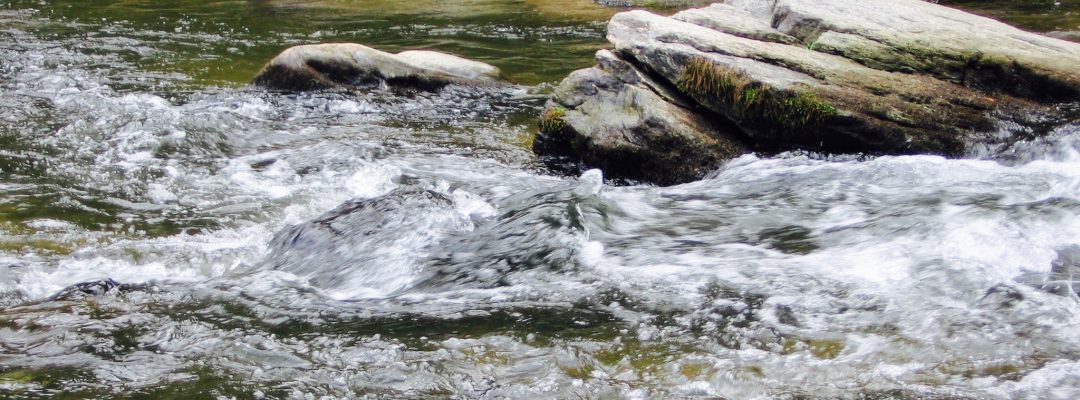
Several years ago my family and I went tubing down a clear mountain river in Saluda, NC. I remember noticing, perhaps for the first time, the number of currents in the water. Some hugged the trees growing on the banks. Some meandered in the middle, and some brought a little spin to my inner-tube. Staying on course was an unexpected challenge. I often fell behind the rest of the group.
Perhaps I was trying too hard. Perhaps not.
That was also the day I unequivocally knew I was ready to have a child. Three months later I got pregnant. Then miscarried. Then the dog died. Two months after that I was in a car accident. My period went wonky and I became anxious that pregnancy wasn’t going to happen.
At day 40 in the 28 day cycle (sisters, you know how yucky that feels) while at a women’s retreat on the coast, I looked out over the water and said a prayer. I felt a pulse beating and pulling up from the center of the earth. A powerful wave crashed at my feet. My period started. Two weeks later I was pregnant with my son.
During that time in between pregnancies, during those days of grief, and injury, and frustration, I finished the first draft of my novel, Decoupage. I taught 7-9 classes a week as well as an online course in Ayurveda. I found my way back to church. Turmoil was everywhere. And so was equanimity. A sense of balance ran deep as I was graced with a visceral connection to an ineffable current, an underground spring. I was “in the flow.” But when am I not? When are we ever not?
Flow is a curious concept and one that carries the unfortunate new age connotation that if we just stop resisting, stop swimming against the current and go with the flow everything will be good. Life will unfold as we like and struggle will cease.
I’d like to interview Jesus, the disciples and all the folks in the bible who answered a call. Who listened and had the courage to say “yes.” Who experienced the first influx of their work unfolding with synchronicity and relative ease then watched as everything fell to pieces. I’d like to ask them the yogic questions, “How did your breathing change? What happened in your shoulders? Your digestive system. How did your attitude toward a situation shift the feeling in your belly?” I’d particularly like these answers as they pertain to the experience of crucifixion.
After giving birth to my son I had this notion that on a primal level I understood the crucifixion. Every moment of labor drenched me in sweat and insecurity. And yet I breathed. It hurt. God it hurt. And still I surrendered to my breath through contraction after contraction after contraction.
There was a moment during the transformation stage that I didn’t breathe. I tensed. I screamed. And I felt my pelvic bones separate like a violent earthquake. I did not resist again. I yelled, I shouted my readiness to be done, but I still breathed. The flow of labor was not tranquil. It was traumatic.
The crucifixion is not the end. It is followed by resurrection. And neither is the whole story. They exist together. As part of one current. Labor is followed by the sweetness of a newborn and the intense challenge of the post-partum days, months, years. White water rapids give way to peaceful waters that may soon cascade down the face of a cliff.
I mention all of this so that you will know what I mean by ease within the flow. I do not mean easiness. I do not mean the end of hardship.
I mean partnership. I mean the Breath as Grace. Grace as the deep current of equanimity guiding the river along its course even as the surface spins out of control. That power that pulls you – pulls me – back from the edge when life is just too much. An unfolding. And an enfolding.
To be in the flow, to find ease in shifting tides, is to answer the call to walk hand in hand with the forces of nature no matter how turbulent. Or tranquil. To swim with the current of Grace.
 The HouseHolder's Path